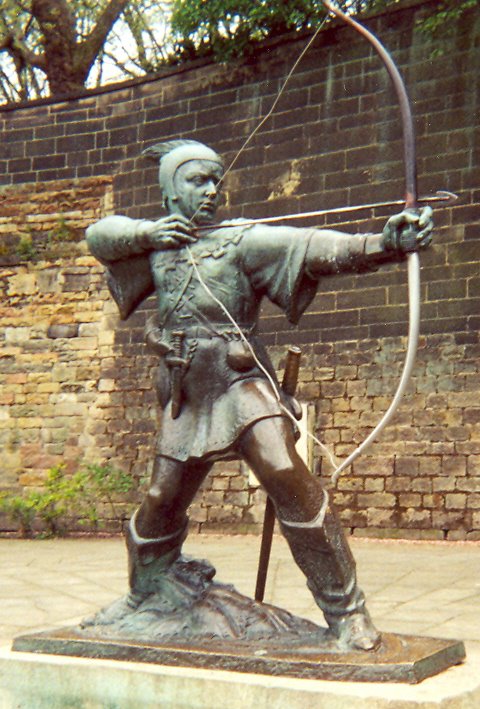
Saturday, June 27, 2009

Surname Scharfe, Yorkshire; Vikings?

Yorkshire and Vikings: Northeast England, a place to visit next time. Of interest here because of Nordic history there, roots, and a recreational interest in names (ours, with Viking roots on both sides, in the names). Vikings!

Scharfes in Yorkshire. A name with Viking roots?

The Vikings began raiding in England in 787 AD. Conquest activity followed. See ://www.localhistories.org/viking.html/. Danes conquered northern England in 866 AD, and the area that once was a Roman city, York, became the capital of Viking rule. Finally in 1016, there came peace with King Canute. Read there about the history of Viking raiding and invasions in Europe, down through Germany, Russia, Eastern Europe, Iceland, Spain (the Muslims defended, kept them out), Portugal, and traded with the Byzantine Empire. In Germany, the root "scharf" in Middle High German meant energetic active person; and scharpf is sharp-cutting, see ://www.ancestry.com/facts/Scharf-name-meaning.ashx/

A blacksmith connection.

Viking craftsmen included blacksmiths, see ://www.localhistories.org/viking.html/ The root of "skarf" with all its spellings wherever the Vikings went comes from forge, or in the Orkneys, shaley place as where cormorants nested, with skarf as a term connected to cormorants (Skarfskerry, Scotland?) see Ireland Road Ways, Scarf - Scharfe - Scharf Ironworking, Norse Is that so? We are just enjoying ourselves here. Not experts.

And in the 1800's, there were four Scharfe families in Yorkshire.
  • Thomas in 1831,
  • Hadassah A. in 1837,
  • Agnes in 1837, and
  • Thomas H. in 1872. See Scharfe Family History at Ancestry.Com at ://www.ancestry.com/facts/Scharfe-family-history-uk.ashx/ This would not be our group, except in name, as our Scharf-Scharfes settled in Ireland.
A Jewish connection
  • There are Polish Jewish Scharfs, see ://www.shoreshim.org/en/trees/treesNamelist.asp?letter=S/
  • Read about Nili Scharf Gold and his research into the poet, Amichai. See ://www.brandeis.edu/information/download/jewishstudies.pdf/ and
  • That Hadassah Scharfe, above.
Interest in Hadassah.

Jews in England - back to the beginnings? There was a massacre of Jews in York in 1190 - there is a Hadassah Scharfe in Yorkshire in the 1890's - see ://search.ancestry.com/cgi-bin/sse.dll?rank=0&gsln=Scharfe&f1=Yorkshire&db=uki1891&gss=genfact/ That is the Hebrew name for Esther, with connections to the myrtle, used in perfume. See ://www.abarim-publications.com/Meaning/Hadassah.html/ Hadassah is also the name of the Jewish women's Zionist organization.

Jewish connections? Given the Viking wanderings, settlements, raids and conquests, that would not be unusual at all.

Looks like it. A Lauren Scharf in Ohio US gave some records to Hadassah the organization there, so is there a Jewish branch of us? See ://www.americanjewisharchives.org/aja/FindingAids/hadassah.htm/ The name comes up. Everybody intermarries with everybody all over the world, so welcome, family. Come to think of it, we were detained in 1961 from entering Israel from Egypt because the "scharfe" was thought to be what? German therefore Jewish or Jewish? We never knew. After an hour we were allowed in. Or was it going from Israel into Syria and Lebanon? Maybe that was it.

The e in our name came only in the 20th Century, to keep all the Ireland-originating Ottawa Scharfs identifiable for the post office. We still would like to know about Hadassah Scharfe.

..........................................

Side interest: "wic" means trading place, see ://www.localhistories.org/york.html/ Eastwick? Southwick? How about Pickwick? Wicca? Wickman? "Land" is a Viking word, and that became attached to the Gaelic "eire" = Ireland. Suder means South, so Sutherland (Scotland at the north). See Viking history at that allhistories site, click and find yourself at ://www.localhistories.org/viking.html/ Upper class Vikings: Earls. Farmers and craftsmen: Karls. See ://www.localhistories.org/viking.html

Wednesday, October 01, 2008

Stonehenge and Healing

Research and archeology never stop. Now Stonehenge is seen, at least partly, as a place of healing, its own Lourdes where those with illness or deformity could come for relief.

See September 2008 articles, at ://www.msnbc.msn.com/id/26838058/

The early pilgrims - these being far distant prehistoric, nothing "Christian," even came from other parts of Europe, not just local. This is the Neolithic era. Some skulls even show signs of surgery (didn't the ancient Egyptians also drill through skulls successfully?), see ://www.usatoday.com/tech/science/2008-09-22-stonehenge-healing_N.htm
Currrent dating: at 2300 BCE (Before Christian Era) see://www.findingdulcinea.com/news/science/September-October/Stonehenge-Said-to-Be-Place-of-Healing.html

Comment reply - We were able to get very close - park across the highway, then follow the pedestrian tunnel underneath to the stones' side. There was a gravel walkway around a tight perimeter, with some stones nearby on the other side of the walkway as well. There was a very light wirey fence, nothing formidable, more a guide. We could not wander freely inside the main area of the stones, however. Everyone stayed on the walkway.

These are too manicured - we did not get elsewhere to famous stone sites in England, but found stone circles and standing stones in the middle of fields. Look up our Orkney and Hebrides sites at Europe Road Ways for the wilder settings for standing stones. More impressive, we thought.

Thursday, May 29, 2008

Wiltshire News: Stonehenge (burials); Sarum, Salisbury area

Wiltshire District -


The area is a layer cake, as this site describes parts of it - history of Sarum, see below, at ://www.timetravel-britain.com/articles/castles/sarum.shtml.


Find successive cultures, religions for the ages. Burial practices, historical developments taking place within short distances, Cathedral, little hamlets with little Norman churches (Mildenhall, for example - there are two Mildenhalls, one north of London with a military base, and then this little village they pronounce as "Minall" if you are looking).


Stonehenge: Fellow Left Just Outside the Circle


Stonehenge.


We were told that this was a place of sun worship - example ://www.english-heritage.org.uk/server/show/nav.16465. New news: With the carbon-dating of cremated remains that had been in storage, archeologists now say that the purpose of Stonehenge is clearer. It was a burial ground, and apparently for rulers that dominated the area for some 500 years. Stonehenge itself dates from about 3000 BC. See://www.chicagotribune.com/news/nationworld/chi-stonehenge_30may30,0,3850894.story


Old Sarum: Work building the banks of the earthwork area began in about 5000 BC - town then on top. It was in use through the time of the Romans and Normans, and finally the center of life moved to Salisbury, about 1219 AD.


"The Sarum Use" is an old liturgy that formed the basis for the later Book of Common Prayer, Church of England, the Common Prayer dating from 1549. View the Sarum Use, parallel Latin and the English, here - at://ia331338.us.archive.org/0/items/theancientliturg00maskuoft/theancientliturg00maskuoft.pdfOr,Or

Or, go first to this site for an overview, and then click to view. See ://justus.anglican.org/resources/bcp/Sarum/index.html; overviews at http://www.britainexpress.com/Where_to_go_in_Britain/Destination_Library/old-sarum.htm.


A new book is coming out on that Sarum Use, says ://www.thecityandthecity.org/2008/04/new-book-on-the-sarum-use/. The liturgy is also known as the Sarum Missal. See ://justus.anglican.org/resources/bcp/Sarum/index.htm.


Good older beach book: "Sarum - A Novel of England," by Edward Rutherford, 1987.


Salisbury. Apparently people needed water and the high earthwork town did not access it easily, thus the move to Salisbury and the vast Cathedral there, see See://www.salisburycathedral.org.uk/; ://www.thetravelinsider.com/britain/salisburyintroduction.htm


Getting around. How do we cover so much in two weeks with a rented car - remember the short distances and small size of European countries. Go back to your globe and superimpose England, for example, on the US. Our car trips are not frenetic at all. They just unfold. Stonehenge, the Salisbury Plain; Old Sarum, 500 BC, see ://www.english-heritage.org.uk/server/show/nav.16426; Salisbury Cathedral, all an easy motorway drive from London and then south - short compared to the distances here. Easy to visit from London to Stonehenge, Stonehenge to Old Sarum, and then to Salisbury for the night.

Sunday, December 30, 2007

Spin-Off Sites - Travelers (Gypsies, Roma) in England

Each country has its own narrative about its Roma, their origins, their past and future. See the "History of Travelling" at www.travellersinleeds.co.uk/_travellers/HistoryEngland.html, for the Roma or Romani or Travellers in Leeds, England. This is a central site for Travellers, with links to various needs and interest groups. It shows by maps and pictures and chronological events where Gypsies came from, and their earliest connections to England.

In England, there is increasing unrest by the community people against the Travellers. See www.abc.net.au/abccontentsales/s1519912.htm. It looks like similar immigration issues are arising worldwide, as peoples cross old boundaries. Distrust, resentment, efforts to dislodge without a place for them to go, etc. And the healthcare provided is abominable, like here. See ://www.news-medical.net/?id=22350. Governments use lots of words about them and great plans. See //83.137.212.42/sitearchive/cre/policy/gypsies_and_travellers.html. Maybe just see that there is healthcare and sustenance and let them travel? Leave a culture alone if they want it?

Our Ireland site provides information on other areas of the British Isles, see Ireland Road Ways, Travellers post, and there is a good overview historical-social-political site at ://www.qub.ac.uk/schools/SchoolofEnglish/imperial/ireland/travellers.htm.

Roma are in the news and media now, especially with the film, "The Golden Compass," This topic is too much for one post, with the film so please visit Gypsies, Roma, Romani. The post on the film is at Golden Compass.

For Scotland and a cultural history angle, see the post on Johnny Fa, the Scottish gypsy in ballads, at 11/12/2007, Johnny Faa.

As to Johnny Faa's surname, we find no connection to the solfege do-re-mi-fa-so-la-ti system - see ://en.wikipedia.org/wiki/Solfege. Will keep looking. Perhaps Mother Faa sang?

Sunday, December 16, 2007

Warwick Castle - A teaching castle


Warwick begins with us in ignorance, and we leave knowing lots. See the scenes set inside with wax mock-ups of historical events. Put yourself there. Go to this tours and photos site for a full view. //www.google.com/firefox?client=firefox-a&rls=org.mozilla:en-US:official. Do a search for Warwick Castle panorama and you will find an interactive site for a 360 all-around tour. This place is becoming very commercialized, but is still worth it - just arrive early or late to beat the buses. Click on the history of Warwick at that site (you have searched for Warwick Castle panorama) - area built as a defense against Danes (read-Vikings), inhabited continuously until recently, home to Earls of Warwick until recently, town destroyed by 17th century disastrous fire, rebuilt, used as setting for many TV and film ventures.